
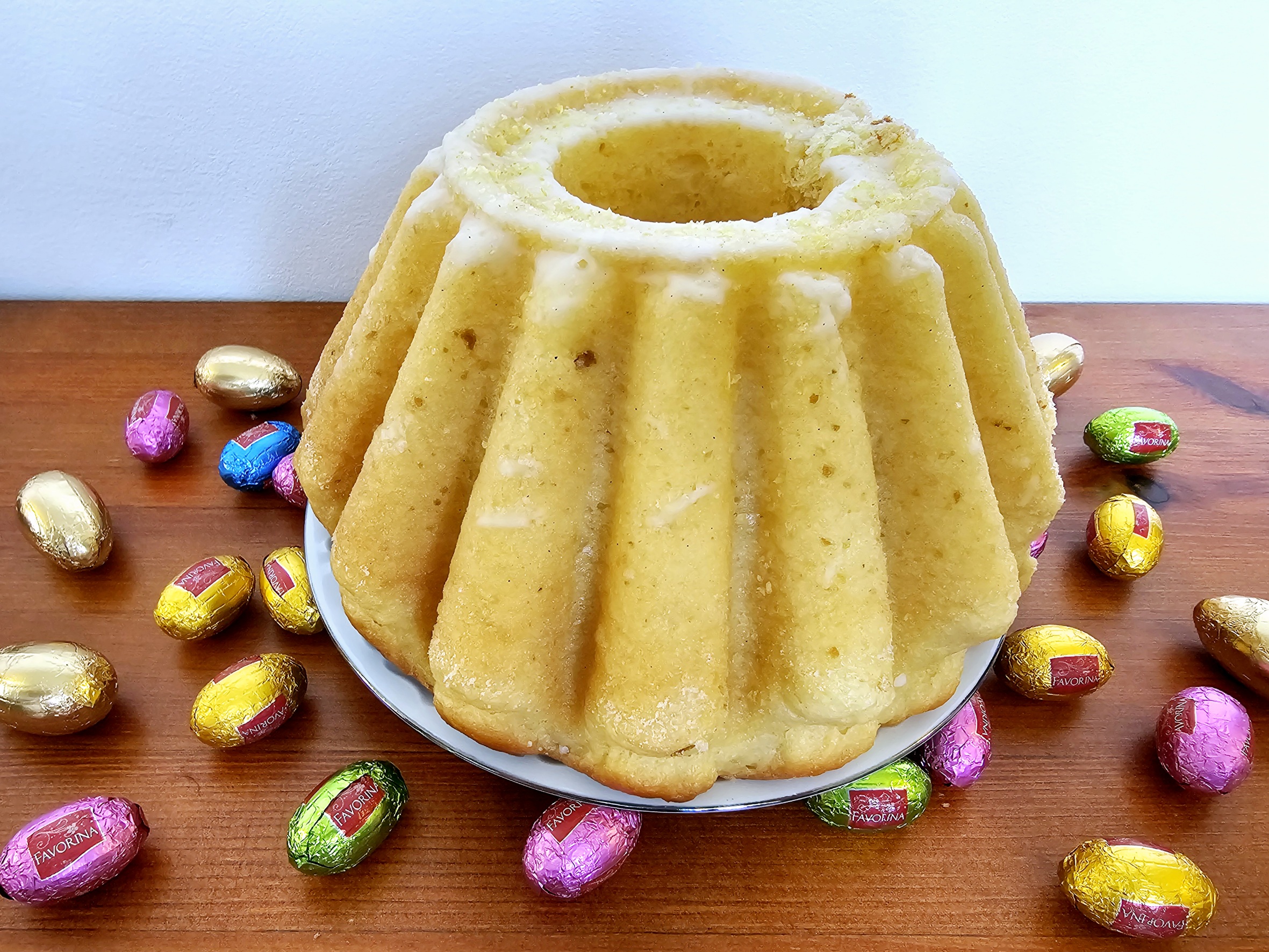
Today, I’d like to share a recipe for one of the two cakes I make for Easter every year. A refreshing, light and fluffy lemon babka cake. As many traditional Polish cakes, it’s made with yeast – that’s how it gets its airy texture. I recommend using fresh yeast if you can find some (Eastern European shops usually sell it), but I included steps for making this cake with dry yeast instead. It’s the perfect cake for spring, whether or not you celebrate Easter. Since I made it for the very first time many years ago, it’s been one of our family favourites and I make it every year. It requires quite a bit of time and effort, but it’s totally worth it!
Ingredients for an Easter lemon babka cake
- 1 3/4 cups (~220g) of plain flour
- 20g fresh yeast or 10g dried yeast
- 3 egg yolks
- 1 small egg
- 1/2 cup milk, lukewarm
- 1/4 cup (~50g) sugar
- 65g unsalted butter
- 1/2 teaspoon lemon extract
- zest from 1 lemon
- pinch of salt
For the lemon soak:
- freshly squeezed juice from 1.5 lemons
- a few teaspoons of icing sugar
For lemon icing:
- freshly squeezed juice from 0.5 lemon
- 1/2 cup of icing sugar
Tools required to make the Easter lemon babka cake
- bundt cake tin
- syringe with a large, thick needle (I got mine from the pharmacy)
- lemon squeezer
- small, fine sieve
How to make a Polish lemon babka cake
Making the lemon babka cake
Melt the butter and set it aside to cool down.
Add the flour to a large bowl.
If using fresh yeast:
- Heat up the milk to warm (but not hot) temperature – slightly warmer than room temperature.
- Take the milk off the heat.
- Add a teaspoon of sugar and a teaspoon of flour. Stir.
- Crumble the yeast into the mixture and set aside (don’t stir). Leave for 15 minutes.
- After 15 minutes, the yeast starter should have risen. Add the whole mixture to the bowl with flour.
If using dry yeast:
- Add the milk and dry yeast to the bowl of flour.
Add the egg and egg yolks to the bowl with flour, milk and yeast. Add lemon extract, lemon zest, sugar and a pinch of salt. Finally, add the melted butter.
Use your hands to knead the dough. Take your time – it should take a good 8-10 minutes for the dough to get less sticky and come together. Don’t worry if it feels a bit greasy – you might think there’s way too much butter, but there’s not. Trust the process.
Once the dough is smooth and elastic, shape it into a ball. Cover the bowl with a tea towel and put it in a warm place to proof, for around 1.5 hours.
I usually cover the bowl with cling film and then a tea towel, to prevent the dough sticking to the towel if it rises too much. It might not be necessary if you use a really big bowl.
Following the traditional Polish way, I always put the covered bowl in my bed and wrap it with the thickest duvet. I follow that method every time I make a cake that includes yeast, and the dough always proofs beautifully. It’s especially helpful in the winter when the room temperature is quite low. You don’t have to do that, but make sure you leave the dough in a draught-free place at the very least.
After the 1.5 hours, the dough should be big and airy. Knead it again – this time only briefly.
Grease a bundt cake tin (mine is 24 cm in diameter on the larger side) with a little bit of soft butter and then coat the butter with breadcrumbs or a tiny bit of flour, shaking off the excess. This will prevent the cake from sticking to the tin.
Transfer the dough to the tin. Try to spread it evenly. Cover the tin with a tea towel and leave it aside to proof again, this time for around 30 minutes.
Pre-heat the oven to 170°C (340°F).
Bake the Easter lemon babka cake for around 25-30 minutes. Use a wooden skewer to check if it’s cooked through – pierce the cake in the middle and then inspect the skewer. If there’s no sticky, raw dough visible on the stick – it means the cake is cooked. Take it out of the oven.
Leave your lemon babka to cool in the tin for 20 minutes, then gently take it out of the mould.
Soaking the Easter babka with lemon juice
This step is optional. I always do it though – this is where the babka will get its distinct lemon flavour.
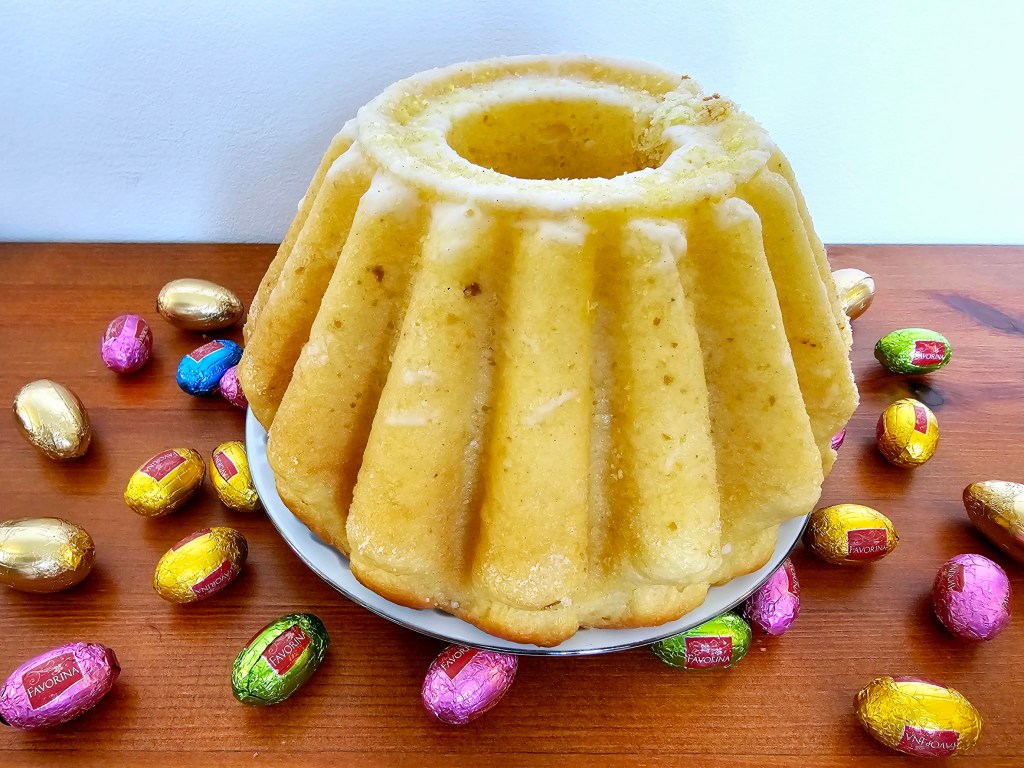
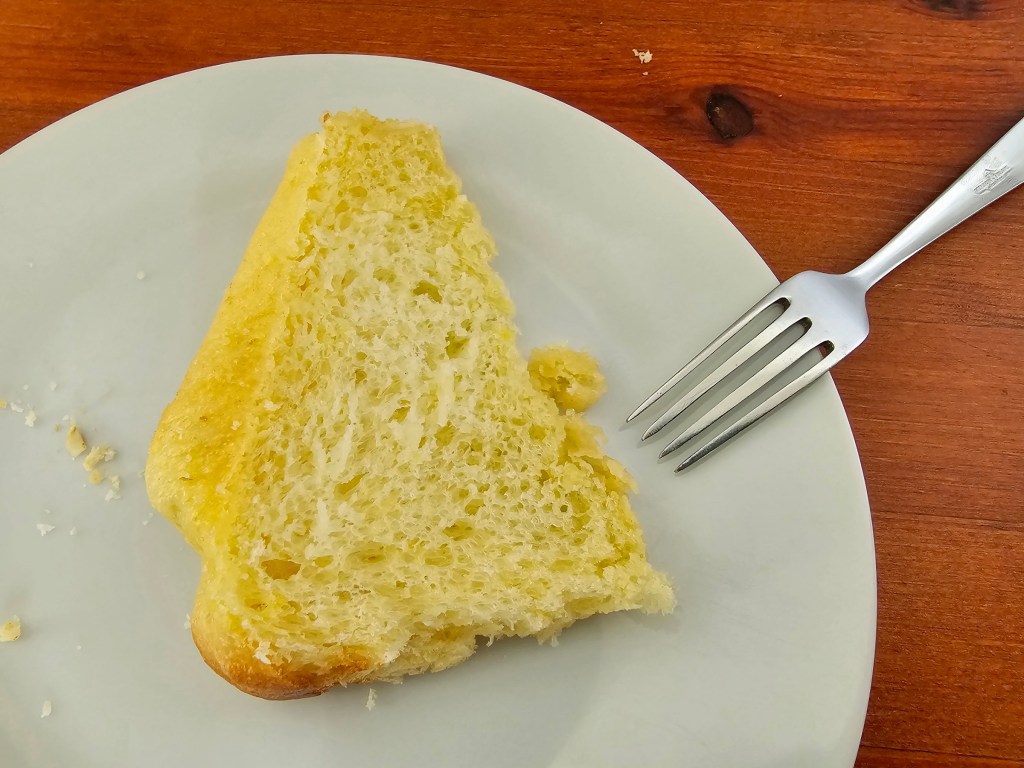
The baked babka will be light and fluffy. Not overly sweet, and with just a subtle hint of lemon. It’s delicious already! You can eat it as is, or proceed to add the lemon icing.
But if you choose to soak the Easter babka with lemon juice, here is how to do it.
Squeeze the juice out of 1.5 lemons (leave the other half of a lemon for icing).
Pour the lemon juice into a glass through a very fine sieve. It’s important to make sure there are no bits of lemon in the glass! It’s should just be clear lemon juice.
Add a tiny bit of icing sugar into the lemon juice and stir. Once dissolved, add a tiny bit more and stir again. Continue adding sugar until you notice that it doesn’t dissolve any more. In total, you should use 3-4 teaspoons of icing sugar.
Now, it’s time to play cake surgeon. Grab a clean syringe with a thick needle – you can get those from a pharmacy, they will be sterile. Fill the syringe with sweetened lemon juice, then slowly inject it into the lemon babka cake. Repeat until you’ve run out of lemon juice, making sure to inject the juice evenly around the cake. Don’t pour a whole syringe worth of juice in one place, or the cake will go soggy in that spot! Add a little at the time, moving around the cake and changing the depth and angle of your juice injections. You can also spray the Easter babka cake with lemon juice from the top.
Once your babka cake is soaked with lemon juice, prepare the icing.
Making lemon icing for the Easter babka cake
Add around half a cup of icing sugar to a bowl. Make sure there aren’t any large crystallized pieces of sugar – sift the sugar it if needed.
Add a teaspoon of the leftover lemon juice and stir until you have a thick paste. Keep adding more lemon juice to create your icing, a few drops at a time. You really don’t need much lemon juice! The icing should be runny enough to easily pour it on top of the cake, but it shouldn’t be thin and completely liquidy. Aim for somewhere between liquid and paste consistency.
Decorate your lemon babka cake with the lemon icing. Leave it in room temperature for a couple of hours for the icing to set.
Enjoy!
How to store lemon babka cake
You can keep the lemon babka cake in room temperature for a couple of days. Make sure to keep it covered, especially once you’ve already cut into it – it will dry out on any uncovered areas.
If you opted to skip soaking the lemon babka with lemon juice, you’ll be able to keep it in room temperature for longer. If you did inject your cake with the lemon juice, it might be a good idea to store any leftovers in the fridge. The wet spots inside the cake might get mouldy quicker than dry cake alone.
This lemon babka cake will definitely taste best when fresh, the same day when it was made, but it’s still delicious in the following days.
Nutritional value of the Polish lemon Easter cake
The whole recipe has approximately 2059 kcal, 77 grams of fat, 300 grams of carbs and 43 grams of protein.
If you slice your cake into 12 portions, each of them will have 171 kcal, 6 grams of fat, 25 grams of carbs and 3 grams of protein. Not too bad for a cake, to be honest!
Bon Appetit!
So there you have it – the lemon Easter babka cake, so loved by my family. I’ve been making it for Easter every year for nearly a decade now, and everyone loves it. If you’re looking for fresh cake recipes to try this Easter, give this lemon babka a go!
Polish Easter Lemon Babka Cake
Refreshing, light and fluffy cake with a hint of lemon
Ingredients
For the cake:- 1 3/4 cups (~220g) of plain flour
- 20g fresh yeast or 10g dried yeast
- 3 egg yolks
- 1 small egg
- 1/2 cup milk, lukewarm
- 1/4 cup (~50g) sugar
- 65g unsalted butter
- 1/2 teaspoon lemon extract
- zest from 1 lemon
- pinch of salt
- freshly squeezed juice from 1.5 lemons
- a few teaspoons of icing sugar
- freshly squeezed juice from half a lemon
- half a cup of icing sugar
Directions
Preparing the dough- Melt the butter and set it aside to cool down.
- If using fresh yeast: heat up the milk to warm (but not hot) temperature. Add a teaspoon of sugar and a teaspoon of flour. Crumble fresh yeast into the milk and set aside for 15 minutes.
- In a large bowl, mix flour, egg yolks, egg, sugar, lemon zest and a pinch of salt.
- If using fresh yeast: add the milky mixture into the bowl with other ingredients.
- If using dried yeast: add the milk and dried yeast into the bowl with other ingredients.
- Add the melted butter.
- Knead the dough with your hands for 8-10 minutes. It should become elastic and less sticky. Don’t worry if some stickiness persists and the dough feels a bit greasy.
- Shape the dough into a ball. Cover the bowl and set it aside for 1.5 hours in a warm place – it should double in size.
- Once the dough has doubled in size, knead it briefly again.
- Grease a bundt cake tin with butter and coat the butter with a thin layer of breadcrumbs or plain flour. Shake off the excess.
- Transfer the dough into the tin, making an even ring around the flute inside the tin.
- Cover the tin with a tea towel and set aside for another 30 minutes, to let the dough rise again.
- In the meantime, pre-heat the oven to 170°C (340°F).
- Bake the lemon babka for 25-30 minutes. Don’t overcook it, or it will come out dry.
- Once cooked, let the babka cool down for 20 minutes, then take it out of the tin.
- Squeeze the juice of 1.5 lemons. Pour it into a glass through a fine sieve to remove any lemon bits.
- Add around 3-4 teaspoons of icing sugar, in small amounts. Stop when you notice that the sugar doesn’t dissolve anymore.
- Using a clean syringe with a thick needle, soak the baked babka evenly. Avoid injecting too much juice in one spot, as it might make the cake soggy. Patiently inject the cake with small amounts of juice in various places.
- Add a teaspoon of lemon juice to the sugar and mix until you get a paste consistency.
- Keep adding the lemon juice, a few drops at a time, until you have a thick glaze – avoid making it too runny. Don’t be tempted to add too much lemon juice.
- Evenly glaze the top of the cake.
Also see:


 Alphe's Corner
Yummy!
LikeLike