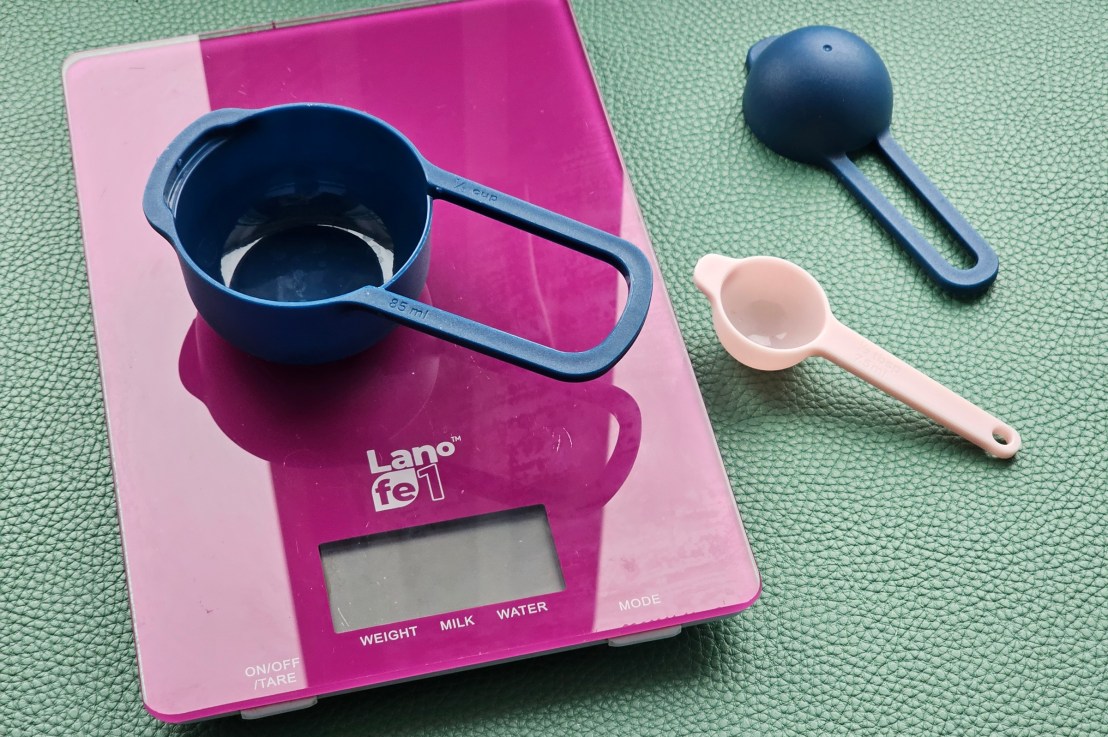
Whenever I post recipes on my blog, sooner or later I get comments about providing ingredient measurements in grams instead of cups. And I get it – it might be frustrating if a recipe requires a kitchen appliance you don’t have. But if there’s a hill I’m willing to die on, it’s this one – scales are a lot more accurate than cups. If you’re still convinced that cup measurements are better, I invite you to read this post, in which I’m going to try to convince you to switch to kitchen scales. I will also give you some tips for using them well, and mention common mistakes. Let’s go!
Are scales really more accurate than cups?
Generally speaking – yes, absolutely. But it all boils down to how you use them.
If you buy analogue scales (which are quite rare these days, to be honest) – they will only give you weight measurements, and may not be too accurate. Digital scales tend to be more precise, but they also often allow you to switch between various units – grams, millilitres, ounces, fluid ounces, and so on. It’s important to note that scales are only accurate in weight units, like grams and ounces. They are not precise with volume, like millilitres and fluid ounces. After all, how would a scale measure volume? It’s not like it has a 3D scanner built-in, is it?
Weight vs volume
So, let’s start by digging into the mechanics of kitchen scales. I will preface it with a short memory of mine.
I once had a girls night with a few friends and we were baking cookies, measuring ingredients on a digital scale. One of the girls weighed the right amounts of flour, sugar, and cocoa, all on the grams setting. It was time to measure 200 ml of milk, and I saw her click through the settings to switch from grams to millilitres. It was at that point when I realised that many people don’t understand how those scales work.
To put it bluntly – the settings for measuring volume are a lie, and they’re only accurate for measuring plain water. That’s because scales, unable to scan the actual volume of the object, convert the object’s weight into volume as if it was water. 1 millilitre of water weighs 1 gram. If you measure 250ml of water on kitchen scales and then switch to gram settings, you will see a measurement of 250 grams. In fact, no matter what you put on the scale – if you switch between millilitres and grams, you will always* see the same number. There’s no point in switching between the two, ever.
* Some scales may have separate millilitre and fluid ounce settings for water and milk – the milk setting won’t be 1:1 for grams and millilitres, but it will still be only accurate for what the scale’s manufacturer considered ‘generic’ milk
What it means, though, is that using the scales to measure in millilitres or fluid ounces isn’t a great idea – at least not always. If you’re measuring water – it’s perfectly fine and accurate. If you’re measuring a liquid of similar viscosity to water, for example milk – the measurement might be slightly off, but good enough for basic cooking. But if you try to measure a liquid much thicker than water – like honey or yoghurt – the volume measurement will be extremely wrong. For example, if you fill a 250 ml container with water, it will weigh 250 grams – and the scale will show 250 ml. But if you fill the same container with honey, it will come to around 350 grams, and so the scale will say that you have 350 ml of honey, even though you only have 250 ml. That’s a huge difference!
Why don’t we just use measuring cups?
So if kitchen scales are bad for measuring volume, doesn’t it mean that we should just use cups in recipes?
Well, no. Cups might be better for measuring volume, but only for liquids. Measuring a cup of water, milk, yoghurt or honey will usually give you a pretty accurate result. But measuring flour in cups? Not at all!
Let me show you a little experiment.
I started off by placing my measuring cup – 1/2 cup size, to be exact – on a scale. I pressed the tare button to account for the weight of the cup itself.
Next, I dipped into a bag of flour to fill the cup. I very gently scooped the flour with the cup, and placed the cup on the scale. The flour weighed 70 grams.
I emptied the cup and put the flour back in the bag, and reset the scale again. I then poured the flour into the cup from the bag. A full cup – seemingly containing the same amount of flour as before – now came to 100 grams.
But then, I used my fingers to press the flour more densely in the cup, which created extra space – so I added more flour in the cup. This time, I had 115 grams in the cup.
Three methods, three different amounts of flour in the cup, even though visually, all of them filled a 1/2 cup measure. Do you see the point? Depending on how densely you pack the dry ingredients in the cup – or how much air is mixed into them – you’ll end up with a different amount of the ingredient. This can ruin a recipe!
So should you use measuring cups for liquids and scales for dry ingredients?
That’s probably the best approach, yes. Dry ingredients, like flour and sugar, should ideally be measured by weight. Liquids, like water, honey, or milk – can be weighed or measured in cups, both approaches are fine. But weight will still be more accurate, especially if you buy cheap measuring cups. I recently checked my old set of measuring cups to see if the sizes printed on the handles were actually right. Surprise surprise – they were not. In fact, they were off by some whopping 30%! So, if you plan to use measuring cups for your liquids – go ahead, just make sure that they’re accurate. There’s an easy way to do it.
How to check if your measuring cups are accurate
You’ll need a scale for this.
Start by placing an empty cup on the scale set to measure in grams. Check the nominal size of the cup in millilitres (most measuring cups include that info).
Tare the scale to account for the weight of the cup itself. It should display 0 grams.
Now, fill the cup with plain water and check the reading in grams. It should show a number very close to the cup’s size in millilitres. If it’s way off – for example, the cup says to be 230 ml but the scale shows 300g or 150g – bin those measuring cups, they’re rubbish. The number will never be perfectly accurate – it will depend on how close you are to the fill line – but it should be somewhat close.
What about measuring spoons?
Recipes often include ingredients measured in teaspoons and tablespoons. Those come with exactly the same issues as measuring cups – especially if you use your dinner cutlery instead of dedicated measuring spoons! Generally speaking, if you need a teaspoon or a tablespoon of something in a recipe, it’s not a big deal if your measuring device is a bit off – you only need a small amount anyway, and it shouldn’t ruin the recipe if your measuring spoon isn’t perfectly accurate. Measuring such small amounts on a kitchen scale typically won’t be any better. Scales, in my experience, have trouble measuring weights under 15 – 20 grams.
If you’re measuring something that has to be precise but you only need a small amount, perhaps consider getting a digital measuring spoon scale? Those look like large spoons, but have a scale built-in. Those scales are designed to accurately measure small amounts of ingredients.
The most important things about kitchen scales
If you decide to buy a kitchen scale – or a spoon-scale for measuring small amounts – there’s one major thing to learn. And that’s using the tare button.
Naturally, when you first turn on a kitchen scale, it will show 0 grams. But as soon as you place a bowl or a cup on it, it will show the weight of the container. You could do the maths in your head when adding the ingredients you need to weigh, but you probably don’t want to. Press the tare button, and the scale should go to 0g. Now, you can easily add your 150 grams of flour. Once all the flour is in, press tare again. The scale goes back to 0g, and you can start measuring sugar. Easy!
Another really important thing about using digital kitchen scales is that they need to lie on a perfectly flat surface, and nothing should be touching them. Balancing a scale on top of an uneven pile of cookbooks covered in crumbs? Bad idea! The reading will be completely off. Make space on the countertop and wipe it clean before you start measuring anything. You’d be surprised how sensitive digital scales can be.
Final thoughts
So that concludes my talk about kitchen scales. If you’re one of those people who get frustrated when they only see recipes in grams, I hope I managed to convince you that there’s a reason behind it. I completely understand that having to buy additional kitchen appliances isn’t for everyone, but I also want my recipes to be precise where it really matters!
Also see:



 Alphe's Corner