
I recently finally had the pleasure of visiting the Royal Observatory in Greenwich – I had been to Greenwich Park many times, but never had a chance to visit the Observatory before. And let me tell you, it was an experience that left me deeply appreciative of something as simple as checking the time. If you’ve ever taken your watch or phone for granted, this place will make you rethink how much we owe to those who struggled to keep accurate time centuries ago!
Prime Meridian Line
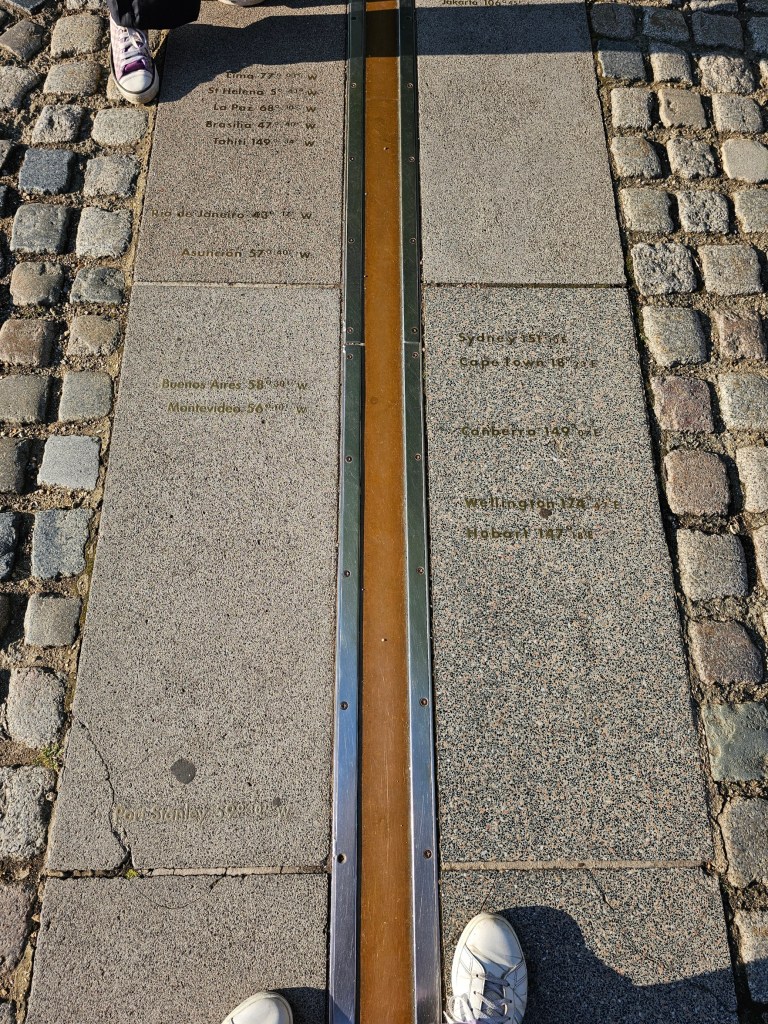
One of the primary reasons why people visit the Royal Observatory in Greenwich is to take a photo standing on the meridian line – with your feet on a different hemisphere each! A little fun fact I learnt at the Observatory is that if you were to stand on the line marked on the ground and check the GPS in your phone, the coordinates wouldn’t show precisely 0° longitude. It turns out that GPS is calibrated to take into account the Earth’s irregular shape, and the 0° line used in GPS is about 100 metres away from the Observatory.

The Struggles of Timekeeping at Sea
One of the most fascinating things I learnt was about the incredible challenges faced in timekeeping during marine voyages a few centuries ago. Imagine being a sailor in the 1700s, navigating the vast oceans with no GPS, no reliable clocks, and only the stars to guide you. Keeping accurate time was crucial because it was directly tied to determining your longitude. Even a small error could mean the difference between landing safely in a port or being lost at sea.
The problem was that clocks at the time couldn’t keep accurate time on a rolling ship. The swinging motion, changes in temperature, and humidity would throw off the delicate mechanisms of traditional clocks. It wasn’t until John Harrison, a self-taught clockmaker, came along that the problem was finally solved. His marine chronometers revolutionised navigation and made long-distance sea voyages much safer. Seeing the old models of these clocks at the observatory, including replicas of Harrison’s pioneering timepieces, really brought home how groundbreaking his work was.

Telescopes Through the Ages
The Royal Observatory is also home to some seriously impressive telescopes, and getting up close to these instruments was a real treat. The observatory has been at the heart of British astronomy since it was founded in 1675, and the telescopes on display are a testament to the evolution of astronomical observation.
One highlight was seeing the Great Equatorial Telescope, housed in its dome with the iconic onion shape. This massive telescope, with its bright red tube, was once the largest of its kind in the world. It’s still used today for public viewing sessions, which is pretty cool if you think about how much history it’s seen. I didn’t have a chance to join such session during my visit, but who knows – maybe one day I will!
The old telescopes reminded me of how far we’ve come in understanding our place in the universe. These early astronomers were looking up at the stars with tools that seem so primitive by today’s standards, yet they made discoveries that laid the foundation for modern astronomy.

The Time Ball Tradition
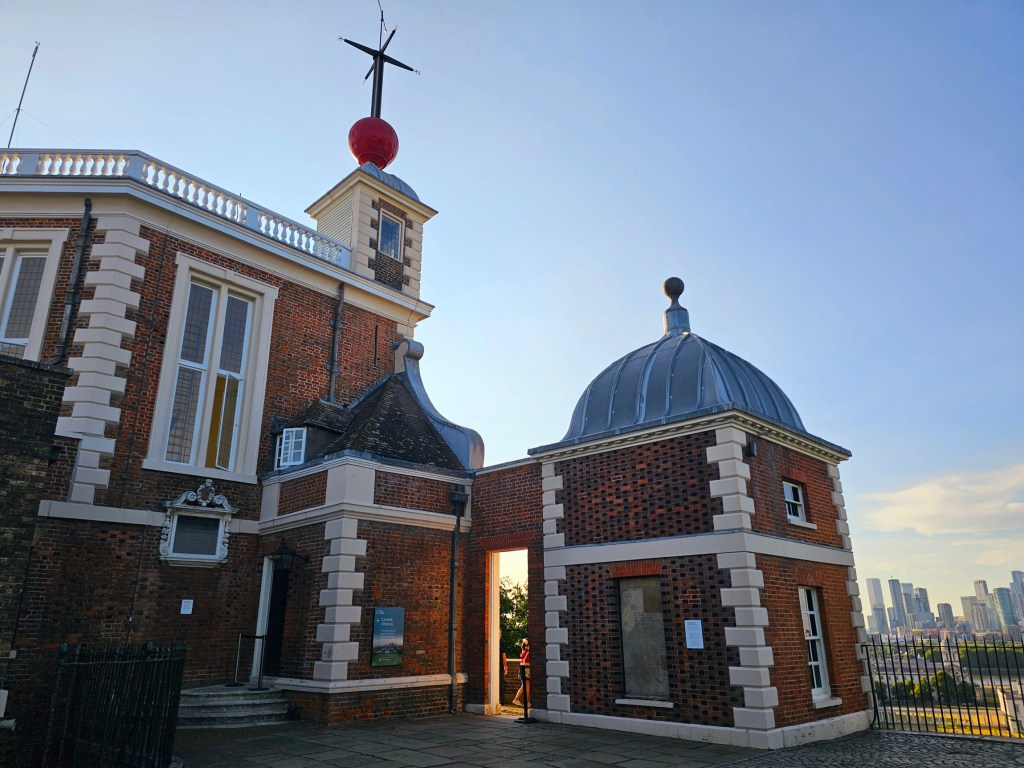
One of the most charming aspects of the Royal Observatory is the daily time ball drop. Every day at precisely 1 pm, a large red ball on top of the observatory’s Flamsteed House is dropped, just as it has been since 1833. Back in the day, this was an essential signal for ships on the Thames to set their clocks accurately. I was in Greenwich on many occasions, often around 1pm, but I never knew about that tradition. In fact, I’ve always thought that the iconic red ball was just part of the building’s architecture. I visited the Observatory in the evening and didn’t have a chance to watch the ball drop, but I will definitely make sure to observe it next time I’m in Greenwich earlier in the day.
Even though we don’t rely on it for navigation anymore, the time ball tradition continues, connecting us to those seafaring days of old. It’s pretty incredible to know that for nearly 200 years, this simple act has been helping to keep time in check. It’s a small but significant reminder of the observatory’s role in the development of accurate timekeeping.
Wrapping Up My Visit
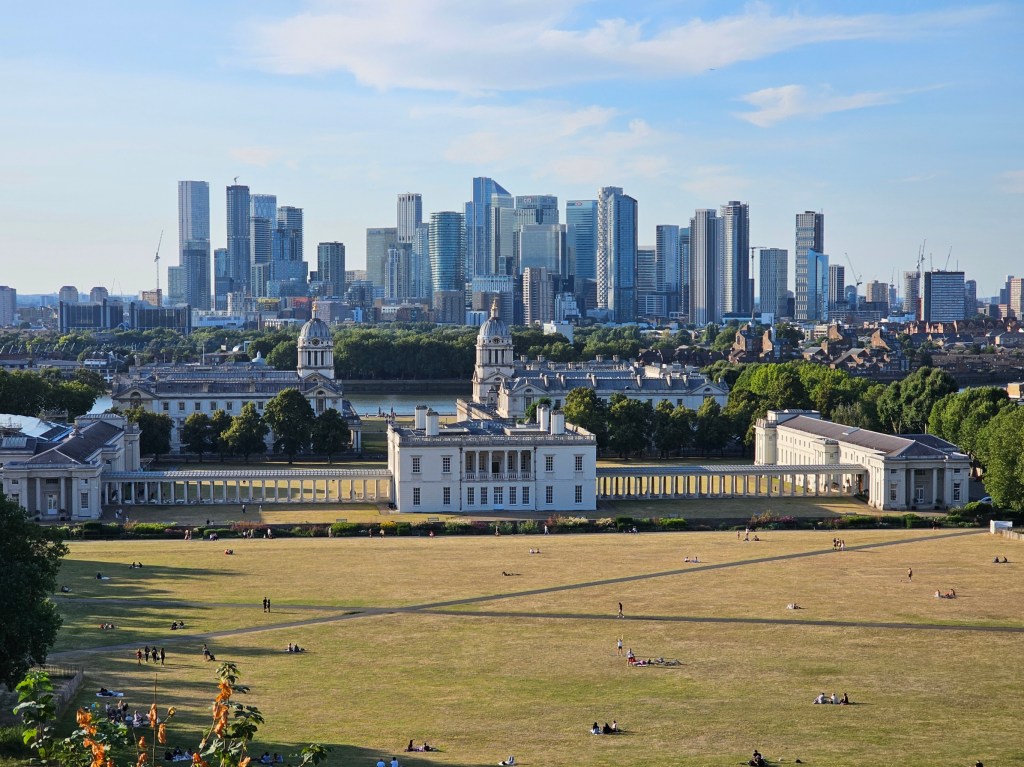
My visit to the Royal Observatory was a journey through time – literally! From the struggles of early timekeeping to the evolution of telescopes, every corner of the observatory is steeped in history. The experience made me appreciate just how much effort went into something as simple as telling the time. And with the daily time ball drop, it’s clear that the Royal Observatory is still very much alive with tradition.
If you’re ever in London, I highly recommend a trip to Greenwich. Whether you’re a history buff, an astronomy enthusiast, or just someone who loves a good story, the Royal Observatory has something for everyone. Plus, you get to stand on the Prime Meridian, with one foot in the eastern hemisphere and the other in the west – how cool is that?
If you’d like to visit the Royal Observatory in Greenwich, London, check out the opening times and ticket prices on its website: https://www.rmg.co.uk/royal-observatory .
Also see:




 Alphe's Corner
One thought on “A Visit To Greenwich Observatory, London, England”